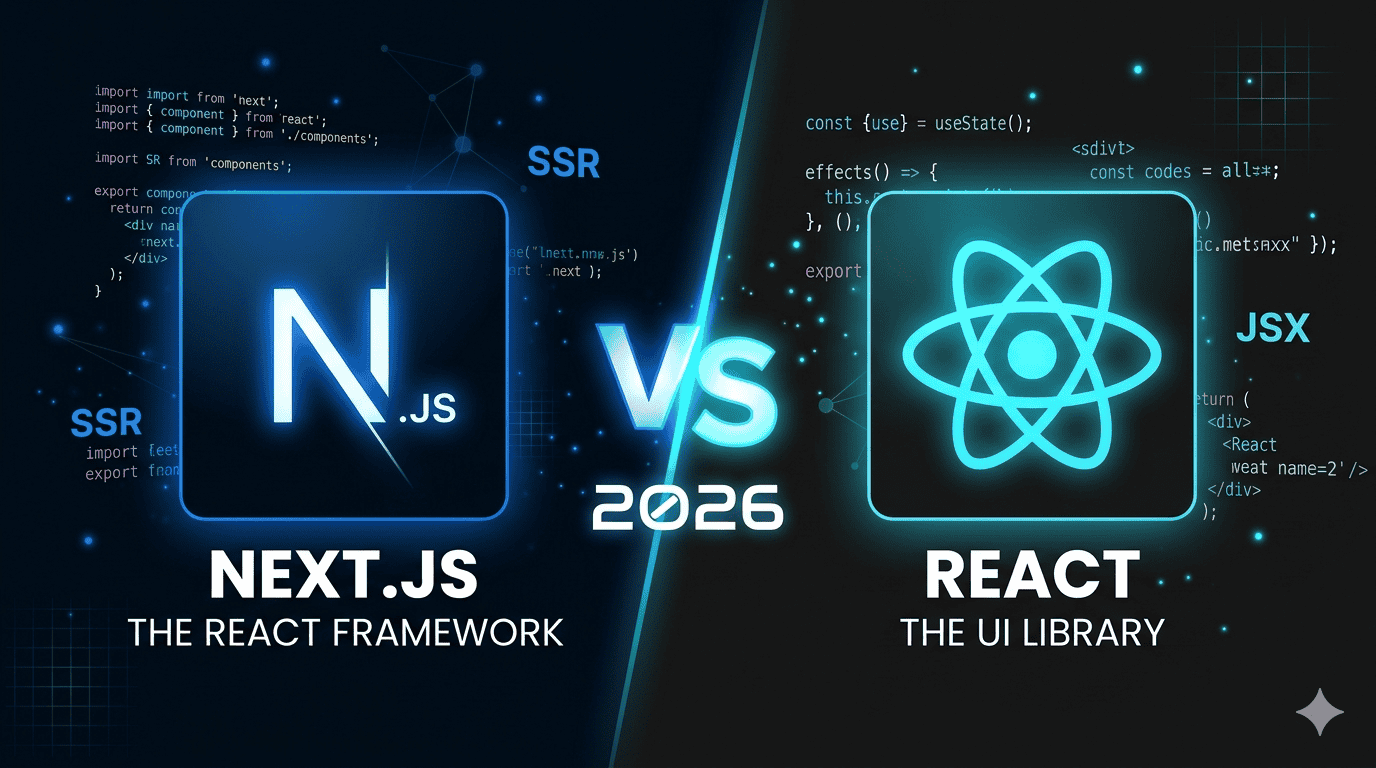
Are you trying to decide between next.js vs react for your next project in 2026? You are not alone. Many Nepali developers and students struggle to pick the right framework for their learning path and career. This guide will help you understand the key differences, use cases, and which one is better for beginners in Nepal. By the end, you will know exactly which technology to invest your time in.
What is React?
React is a JavaScript library developed by Facebook for building user interfaces. It uses a component-based architecture that allows developers to create reusable UI components. React handles the view layer of your application and is excellent for building single-page applications.
React follows a unidirectional data flow where data moves from parent to child components through props. This makes debugging easier and your code more predictable. Components in React can be functional or class-based, though functional components with hooks have become the standard in modern React development.
Key features of React include:
- Virtual DOM for fast rendering and minimal direct DOM manipulation
- Component-based architecture for code reusability
- Rich ecosystem with tools like Redux, React Router, and Axios
- Strong community support and extensive documentation
- React Native for building cross-platform mobile applications
React Ecosystem in 2026
React has evolved significantly in recent years. With React Server Components and improved concurrent features, React in 2026 is more powerful than ever. However, React alone does not provide routing, data fetching, or SEO optimization out of the box. You need additional libraries to build a complete production-ready application.
Popular tools in the React ecosystem include React Router for navigation, Redux Toolkit or Zustand for state management, and Axios for API calls. The flexibility of React means you can choose your own tools, but it also means more decisions to make as a developer.
For a complete guide, check out the React.js Tutorial for Beginners on this blog.
What is Next.js?
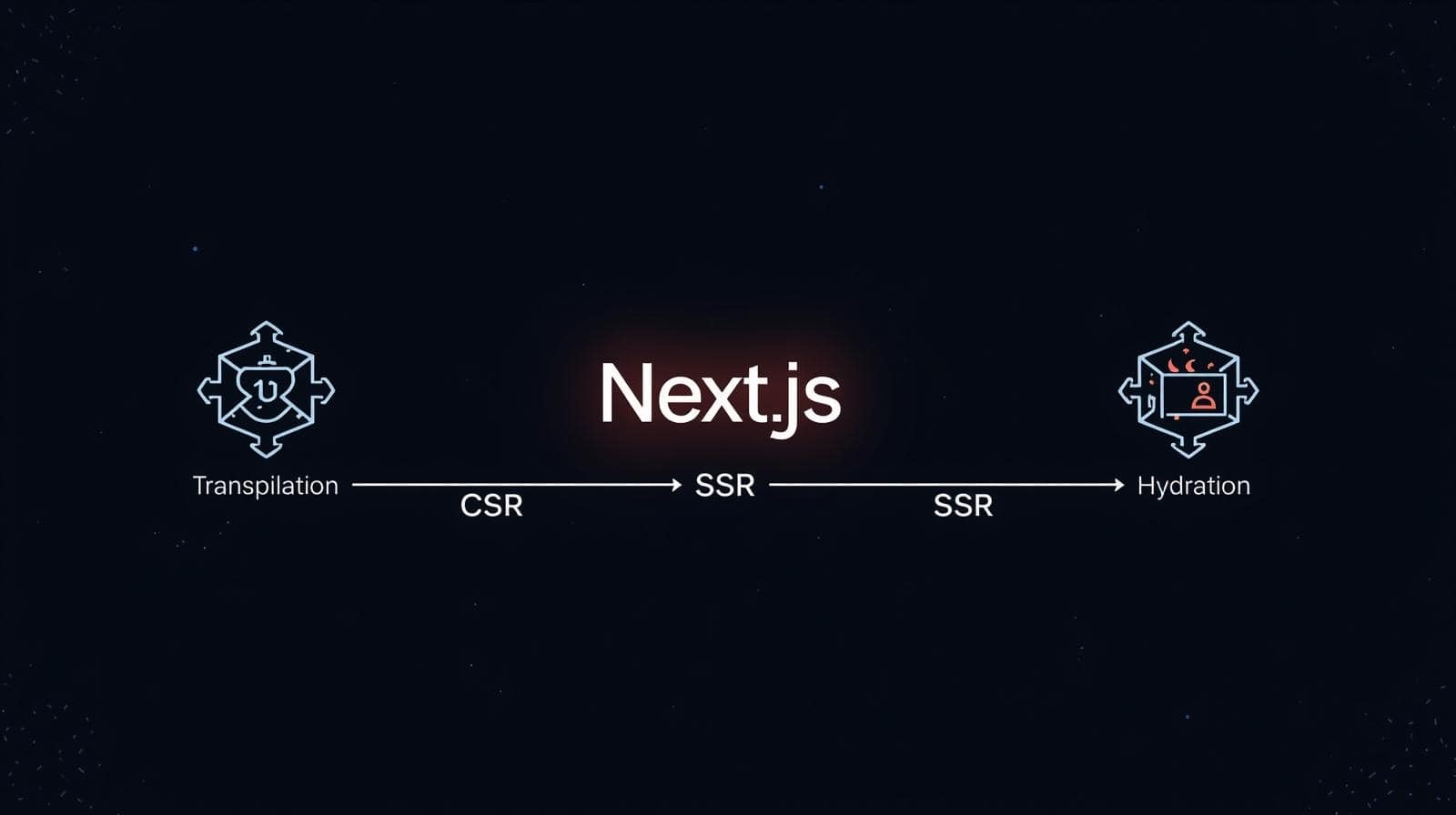
Next.js is a React framework created by Vercel that provides a complete solution for building production-ready web applications. It extends React with server-side rendering, static site generation, API routes, file-based routing, and image optimization. When comparing these two technologies, Next.js is essentially React plus everything you need to build a full application without piecing together multiple libraries.
Next.js simplifies the development process by providing conventions and built-in solutions for common tasks. Instead of setting up Webpack, configuring routing, and choosing a data fetching strategy, Next.js handles all of this automatically. This makes it an excellent choice for developers who want to focus on building features rather than configuring tools.
Key features of Next.js include:
- Server-Side Rendering and Static Site Generation for better performance and SEO
- File-based routing system that mirrors your project folder structure
- API routes for building backend logic without a separate server
- Built-in image and font optimization for faster page loads
- Middleware and edge functions for advanced request handling
Next.js vs React Framework Comparison: What Sets Them Apart
By 2026, Next.js has matured with the App Router as the standard, React Server Components deeply integrated, and partial prerendering available. The framework has become the go-to choice for production React applications. Understanding the next.js vs react difference at the framework level helps you decide which tool fits your project.
Explore the Next.js Notes: Full Guide for Beginners to Advanced to learn more.
Next.js vs React: Key Differences
| Aspect | React | Next.js |
| Type | Library | Framework (built on React) |
| Routing | Requires React Router | Built-in file-based routing |
| Rendering | Client-side only | SSR, SSG, ISR, CSR |
| SEO | Poor | Excellent |
| API Routes | Requires separate backend | Built-in API routes |
| Image Optimization | Manual setup | Built-in Image component |
| Data Fetching | useEffect or libraries | Server Components, SSR |
| Bundle Size | Smaller | Larger |
| Learning Curve | Moderate | Steeper |
| Deployment | Any static host | Vercel or Node server |
This comparison table shows that React gives you flexibility while Next.js provides a complete toolkit. Your choice depends on your project requirements and career goals.
Which is Better: React or Next.js for Beginners?
If you are a beginner in Nepal wondering whether to learn React or Next.js first, here is the honest answer: learn React first. React is a library with a smaller scope, making it easier to understand core concepts like components, state, props, and hooks without the complexity of a full framework.
Once you have a solid React foundation, moving to Next.js becomes natural because Next.js is React with superpowers. Many Nepali students make the mistake of jumping directly into Next.js without understanding React fundamentals, which leads to confusion and frustration. Learning in the right order saves you time and builds deeper understanding.
Here is the recommended learning path for Nepali developers:
- Learn HTML, CSS, and JavaScript basics thoroughly
- Master React fundamentals including components, state, props, and hooks
- Build 2 to 3 real-world projects with React to solidify your skills
- Learn Next.js for production-ready applications
- Explore full-stack development with Next.js API routes
Common Mistakes Beginners Make
Many beginners try to learn both React and Next.js simultaneously. This approach leads to information overload. Focus on React first. Once you understand how React components work and how state management functions, Next.js concepts like server components and file-based routing will feel intuitive.
Another common mistake is spending too much time on tutorials without building projects. Theory without practice leads to weak skills. Build a simple todo app, a weather dashboard, or a blog with React before moving to Next.js. Practical experience is what makes you a confident developer.
A third mistake is ignoring JavaScript fundamentals. Many beginners jump into React without understanding closures, promises, async await, array methods, and ES6 features. Strong JavaScript skills make learning React and Next.js much easier.
Next.js vs React for Nepali Developers in 2026
For Nepali developers in 2026, the next.js vs react decision depends on your career path. If you want to work as a frontend developer, React skills are essential because many IT companies in Nepal use React. If you aim for full-stack or modern web development roles, Next.js gives you a competitive edge in the job market.
The job market in Nepal increasingly demands Next.js knowledge. With remote work opportunities growing, international clients prefer developers who can build SEO-friendly, high-performance applications. Next.js delivers exactly that.
Check the Full-Stack Roadmap for Nepali Developers for a complete learning plan tailored to Nepal.
When to Choose React Over Next.js
React is the better choice in these scenarios:
- Building a single-page application with no SEO requirements
- Creating a dashboard or admin panel behind authentication
- Building a mobile app with React Native using the same library
- Prototyping quickly without framework overhead
- Working on a project where the team already knows React
React shines in interactive applications where SEO is not a concern. For example, a BCA student project like a college event management system works perfectly with React alone.
When to Choose Next.js Over React
Next.js is the better choice in these scenarios:
- Building a content website or blog that needs Google rankings
- Creating an e-commerce site that needs fast page loads
- Building a full-stack application with built-in backend APIs
- Developing a marketing site that ranks on search engines
- Working on any project that needs server-side rendering
If you are building a portfolio website, a blog, or a client project that needs to rank on Google, choose Next.js. The built-in SEO features alone make it worth the investment.
Next.js vs React: Job Market in Nepal
The job market for both React and Next.js developers in Nepal is growing rapidly in 2026. Here is what you need to know:
- React jobs: More numerous, especially for frontend roles in Nepali IT companies
- Next.js jobs: Growing faster, especially for remote and international positions
- Freelancing: Next.js skills attract higher-paying clients due to SEO and performance benefits
- Salary: Next.js developers often earn 20 to 30 percent more than React-only developers in Nepal
Learning both technologies makes you a versatile developer. Start with React, then add Next.js to your skillset for maximum career opportunities and higher income potential. Companies in Nepal like freelance platforms, outsourcing firms, and startups are actively hiring developers who can work with both React and Next.js.
For BCA students and fresh graduates in Nepal, having Next.js on your resume makes you stand out from the competition. Many job postings on platforms like LinkedIn and local Facebook groups specifically mention Next.js as a preferred skill. Investing time in learning both frameworks pays off in the long run.
To stay updated with the latest web development trends, follow the official React Documentation and the Next.js Official Website.
Frequently Asked Questions
What is the main difference between next.js vs react?
The main difference between next.js vs react is that React is a JavaScript library for building UI components, while Next.js is a full framework built on React that adds server-side rendering, routing, API routes, and other production features out of the box.
Should I learn React before Next.js?
Yes, you should learn React before Next.js. React provides the foundation. Once you understand React components, state, and hooks, learning Next.js becomes much easier. Most Next.js concepts build directly on React knowledge, so skipping React will only slow you down.
Which has better job opportunities in Nepal: React or Next.js?
React has more job openings in Nepal currently, but Next.js jobs are growing faster and often pay higher salaries. Learning both gives you the best career prospects. Many companies now specifically ask for Next.js experience in their job postings for senior roles.
Can I use Next.js without knowing React?
Technically yes, but it is not recommended. Next.js is built on React, so you need React knowledge to build components effectively. Jumping into Next.js without React fundamentals will make learning harder and slower. Always learn React first.
Is Next.js replacing React in 2026?
No, Next.js is not replacing React. Next.js depends on React. They work together. Next.js is a framework that enhances React with additional features. React continues to evolve independently, and you need React skills regardless of whether you use Next.js for your projects.
Conclusion
Choosing between next.js vs react in 2026 does not have to be difficult. React is the foundation you must learn first. Next.js is the production framework that makes React applications SEO-friendly, fast, and full-stack ready. As a Nepali developer, learning React first and then adding Next.js to your skillset is the smartest career move. Start with React, build real projects, then level up to Next.js for better job opportunities and higher income. Join the WebDevByte Telegram group to connect with other Nepali developers learning these technologies. Leave a comment below if you have questions about your learning path.