digital résumé, your technical showcase, and often the first impression
recruiters, clients, and other developers have of your work.
Many developers spend months learning frameworks like React or Next.js but
never invest time in building a portfolio that reflects their skills. As a
result, they miss opportunities to demonstrate how they solve problems,
structure applications, and write maintainable code.
In this tutorial, you’ll build a production-ready developer portfolio using
Next.js 15, TypeScript, and
Tailwind CSS. Instead of focusing only on appearance,
we’ll cover the architecture, performance, accessibility, SEO, and
deployment practices used in real-world applications.
Unlike many portfolio tutorials that stop after creating a few static
sections, this guide walks you through building a complete portfolio that
is scalable, maintainable, and optimized for search engines. By the end,
you’ll understand not only how to build the project, but also why each
architectural decision matters.
What You’ll Build
Throughout this tutorial, you’ll create a fully responsive portfolio
website that includes:
- A modern landing page with a professional hero section
- Responsive navigation with mobile support
- About, Skills, Experience, and Services sections
- A featured projects section with reusable project cards
- Dynamic project detail pages
- A Markdown-powered blog
- A contact form with validation
- Dark mode with theme persistence
- Smooth page transitions and animations
- GitHub profile integration
- Search engine optimization using the Metadata API
- Open Graph and Twitter Card support
- Structured data (JSON-LD)
- Performance optimizations for Core Web Vitals
- Accessibility improvements for keyboard and screen reader users
- Deployment to Vercel with a custom domain
By the time you finish this guide, you’ll have a portfolio that is suitable
for showcasing to employers, freelance clients, and the developer
community.
Why Next.js 15?
Next.js has become one of the most widely adopted React frameworks because
it provides excellent performance, file-based routing, server rendering,
and built-in SEO capabilities. Version 15 continues to improve the
developer experience with faster builds, better caching behavior, and
enhanced support for the App Router.
For a portfolio website, these features provide significant advantages:
- Faster page loads improve user experience and search engine rankings.
- Server Components reduce unnecessary JavaScript sent to the browser.
- Built-in image optimization improves loading performance.
- Metadata APIs make SEO implementation straightforward.
- Static generation enables fast, globally distributed pages.
- Automatic code splitting keeps bundles small and efficient.
These capabilities allow you to build a portfolio that is both visually
impressive and technically optimized.
Who Is This Tutorial For?
This guide is designed for developers who already understand the basics of
HTML, CSS, JavaScript, and React. Previous experience with Next.js is
helpful but not required.
Whether you’re a student building your first portfolio, a frontend
developer refreshing your personal website, or an experienced engineer
exploring the latest features in Next.js 15, you’ll find practical
techniques that can be applied to production projects.
What You’ll Learn
By following this tutorial, you’ll learn how to:
- Structure large Next.js applications
- Organize reusable UI components
- Build responsive layouts with Tailwind CSS
- Implement dynamic routing using the App Router
- Create reusable project components
- Optimize images and fonts
- Improve Lighthouse performance scores
- Add modern animations without sacrificing performance
- Implement technical SEO best practices
- Deploy a production-ready application to Vercel
More importantly, you’ll understand the reasoning behind each decision so
you can confidently apply the same patterns to future projects.
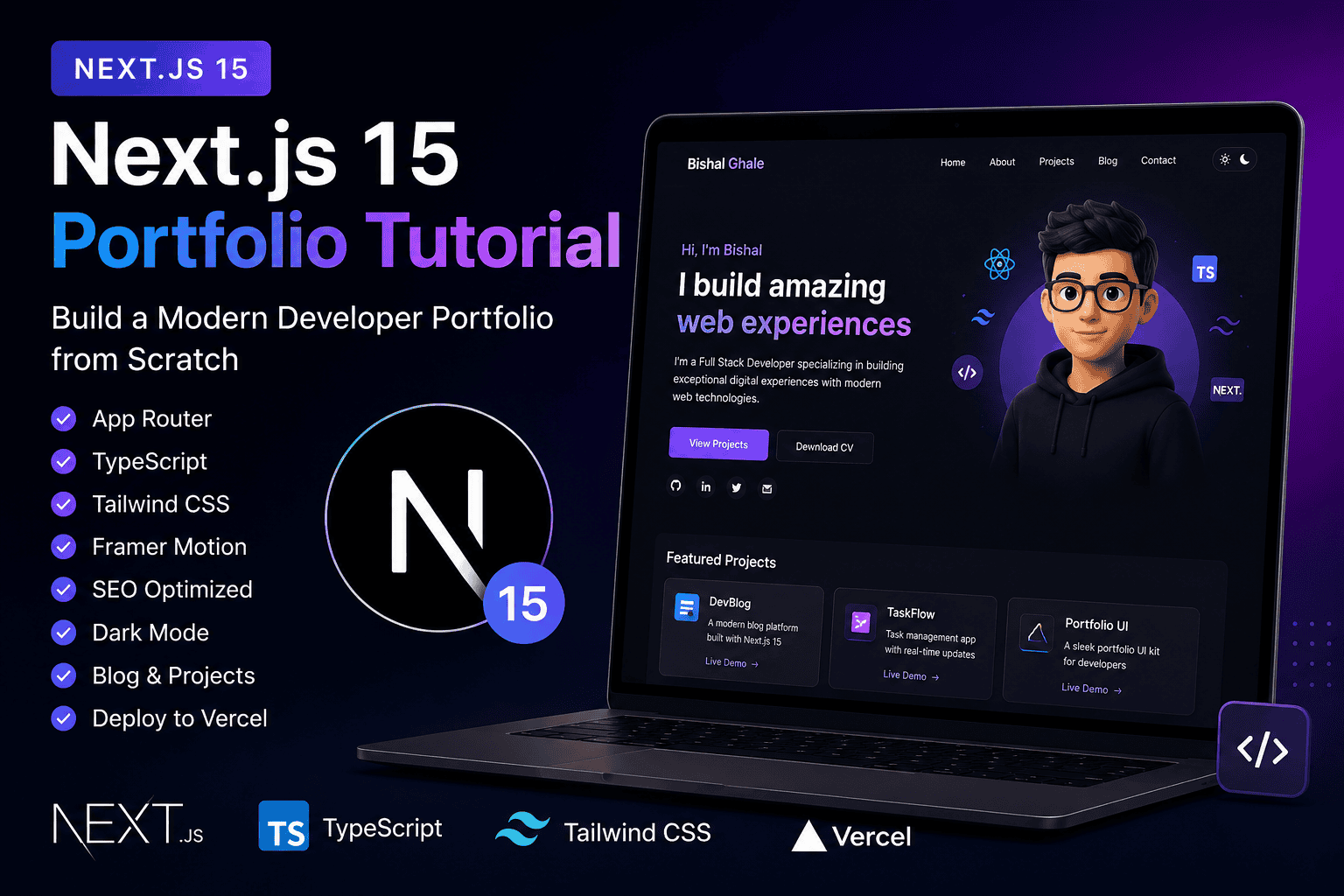
Project Preview
The final portfolio will be fast, accessible, mobile-friendly, SEO
optimized, and easy to extend. Instead of a one-off demo, you’ll end up
with a portfolio that can evolve alongside your career.
As your experience grows, you can continue adding projects, blog posts,
case studies, and new sections without restructuring the entire
application. This makes the portfolio a long-term asset rather than a
short-lived tutorial project.
Let’s start by exploring why Next.js 15 is one of the best
choices for building modern portfolio websites.